
STRATEGIC INSIGHTS
The Hidden Cost of Operational Chaos in Scaling Business
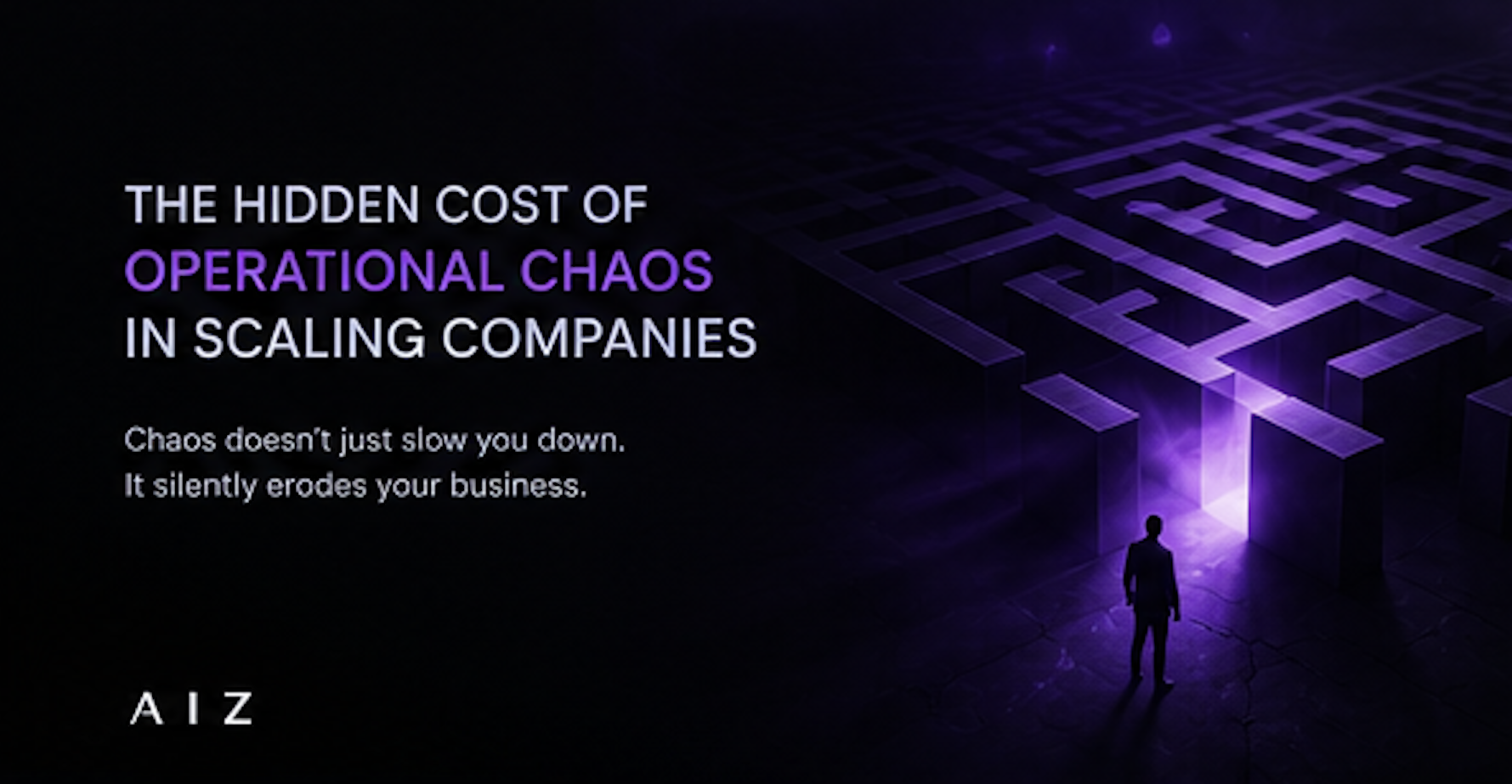
Growth without systems creates hidden friction. From Fragmented Operations to tool overload, operational chaos quietly erodes margins, slows teams, and prevents sustainable scale.
The Hidden Cost of Operational Chaos in Scaling Companies
Growth is often romanticised.
More Revenue. More hires. More customers. More tools.
From the outside, expansion looks like progress.
But inside many growing companies, rapid growth often masks something less attractive… operational chaos.
It rarely announces itself dramatically. Instead, it appears quietly through fragmented workflows, duplicated effort, bloated software stacks, misaligned teams, and decision-making bottlenecks that compound over time.
Many businesses assume their biggest challenge is growth.
In reality, their biggest challenge is often what growth exposes.
Without structured systems, operational clarity, and scalable infrastructure, growth can become an amplifier or inefficiency rather than a driver of enterprise value.
Chaos Doesn’t Always Look like Failure
Operational Chaos can exist even inside companies that appear successful.
Revenue may be rising. Teams may be expanding. New software may be added regularly.
But beneath that momentum, warning signs often emerge:
- Teams relying on disconnected tools
- Sales, finance, and operations working from different data
- Manual reporting consuming leadership bandwidth
- Customer delivery becoming inconsistent
- hiring increasing faster than productivity
- Software costs rising without corresponding efficiency gains
This is where many business fall into a dangerous trap.
They mistake motion for maturity.
Adding tools without architectural thinking creates complexity, not capability.
The Real Hidden Costs
1. Decision Latency
When data is fragmented, leaders make slower and often poorer decisions.
If finance operates in one platform, sales in another, and operations through spreadsheets, every strategic move becomes slower.
Delayed visibility creates delayed action.
In fast moving markets, delay itself becomes a cost center.
2. Labour Waste
Operational inefficiency often leads companies to hire more people when the actual problem is poor systems design.
Instead of solving root inefficiencies, businesses frequently add headcount to compensate.
This creates payroll inflation without true operational leverage
3. SaaS Bloat
Modern businesses often accumulate software reactively.
A CRM here. A project management platform there. An automation tool no one fully owns.
Over time, this creates subscription sprawl, overlapping functionality, inconsistent adoption, and unnecessary overhead.
Software should creat clarity. Too often, it creates confusion.
4. Execution Drift
Without aligned systems, strategy degrades during execution.
Leadership may define priorities clearly, but operational friction prevents those priorities from translating effectively across teams.
The result? Vision at the top. Chaos in the middle. Inconsistency at the bottom.
Why This Becomes More Dangerous During Scaling
Small companies can simetimes survive operational disorder because complexity is lower.
Scaling changes that. Fast.
As customer volume, employee count, sales channels, and strategic initiatives increase, weak systems create exponential strain.
What once felt manageable becomes structurally dangerous.
This is why many buisiness plateau.
Not becauxse demand disappears. But because operational Infrastructure cannot support the next stage.
Systems Create Scale, Not Just Effort
Companies thar scale intelligently are rarely overcome by inefficient workflows, creating a false sense of being busy.
They are however, often the clearest.
They understand that;
- Systems outpreform improvisation
- Process reduces margin leakage
- Visibility improves strategic speed
- Ownership matters more than software
Operational maturity is not about complexity. It’s about clarity.
A Better Model: Strategic Operational Design
To move from chaos to effective scaling, businesses need more than software impelementation.
They need operational architecture.
This includes;
Systems Audit
Identify;
- Tool redundancy
- Workflow bottlenecks
- Manual Dependencies
- Reporting Inefficiencies
Infrastructure Simplification
Reduce unnecessary complexity. Consolidate where possible. Build with scalability in mind.
Automation with Intent
Automation should not simply accelerate broken processes. It should improve process integrity.
Cross Functional Visibility
Ensure finance, sales, delivery and leadership share alligned operational intelligence.
The Strategic Shift
The querstion is no longer “what tools do we need?”
The better question is “what operating system does this business actually need to scale effectively?”
That shift changes everything
Final Thought
Operational Chaos is expensive precisely because it often hides behind growth.
Many businesses do not realise how much revenue, energy, and strategic momentum they lose until inefficiency becomes too large to ignore.
The companies thay win long term are rarely those with the most tools.
they are the ones with the clearest systems.
Growth creates opportunity.
Systems & architecture determine whether that opportunity compounds… or collapses.