
STRATEGIC INSIGHTS
Automation vs Operational Inteligence:
The Difference Between Efficiency & Scale
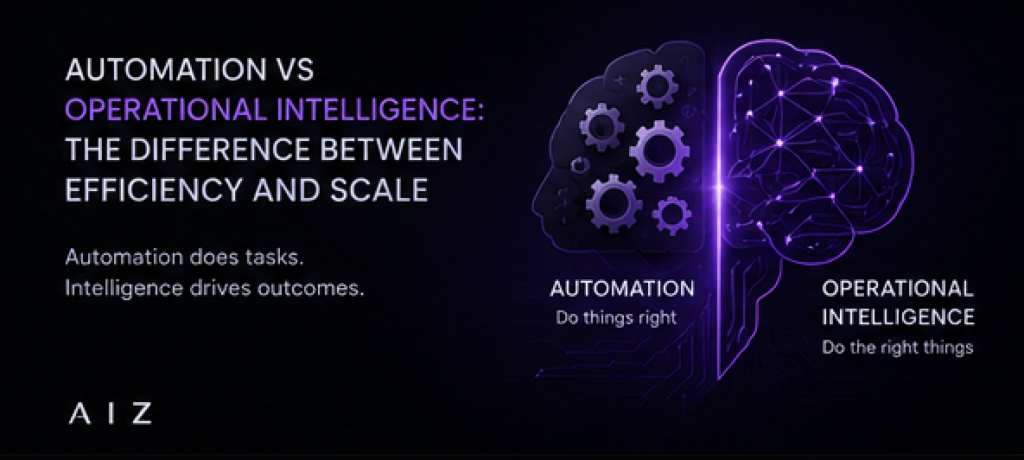
Automation alone does not equal scale
There’s a subtle but important misconception floating around modern businesses right now.
If we automate enough processes…
We assume we become more scaleable.
If we reduce manual work…
We assume we are “digitally transformed.”
But in reality, most organisations are not scaling effectively.
They are just speeding up what already exists.
And if what already exists is fragmented, inconsistent, or poorly understood… All you’re really doing is accelerating inefficiency.
This is where the distinction between automation and operational intelligence becomes critical.
Because they are not the same thing.
Not even close.
Automation
Automation, at it’s core, is mechanical.
It takes a defined process and executes it repeatedly without human intervention.
Send this email when X happens.
Move this data when Y is updated.
Trigger this workflow when Z occurs.
It is incredibly useful.
In fact, in most organisations, automation delivers immediate wins:
- Time saving
- Reduced manual effort
- Faster task completion
- Lower operational friction.
No serious business should be operating without it.
But there’s a small problem.
Automation assumes one thing;
That the process or architecture you are automating is already best practice.
In most businesses, it isn’t – and through no fault of their own, most businesses will go through this transitionary period during scaling.
The original focus is usually seeing a problem in the market and creating and delivering a solution to solve it.
It’s just familiar.
This is where things start to break.
Because you can automate a bad process or work flow beautifully…
and still end up with an undesired outcome.
Just delivered faster.
Operational Intelligence: Understanding how work actually flows
Operational intelligence is something different entirely.
It is not about doing tasks faster.
It is about understanding:
- How work actually moves through the organisation
- Where decisions are made
- Where bottlenecks form
- Where data becomes unreliable
- Where human judgement is required vs system logic
It’s the difference between;
“we automated our process”
and
“we understand how our system actually behaves under real-world conditions”
This is where the real scalability lives.
Because once you understand how your organisation actually operates, you can begin to design architecture intentionally & scaling and automation actually becomes an asset rather than lost & siloed data, crashes – and endless frustration.
Why automation fails without operational intelligence
Most automation initiatives fail quietly.
Not because the tools are bad.
But because the underlying system was never fully understood in the first place.
Common patterns look like this;
- Automations break when edge cases appear
- Data becomes inconsistent across systems
- Teams build workarounds outside the system
- Reporting no longer reflects reality
- Decisions are made based on incomplete signals
At this point, automation is still running.
But it’s running blind.
You’ve essentially built a machine that executes logic you no longer fully trust.
That is not efficiency.
That is accelerated uncertainty.
Operational intelligence is what turns systems into scale
Where automation improves execution speed, operational intelligence improves decision quality.
It allows organisations to:
- Identify which processes should not exist at all
- Redesign workflows based on actual usage, not assumptions
- Align data structures with real operational behaviour
- Reduce dependency on individual knowledge or “tribal systems”
- Build clarity into how decisions are made and executed
This is the layer most business skip.
And it’s also the layer that determins whether automation compounds value.. or compounds chaos
The uncomfortable truth about the most “digital transformation”
If you strip away the language, a lot of digital transformation projects are simply;
- Tool implementation
- Process digitisation
- Workflow automation
Very little of it is true operational redesign.
This is something consistently reflected in industry analysis from firms like Gartner, which as repeatedly noted that a large percentage of transformation initiatives fail to deliver expected value due to misalignment between technology implementation and business process design.
In simpler terms:
Companies modernise the tools… without modernising the system.
And then wonder why nothing fundamentally improves.
So what does operational intellligence actually look like?
It is not a dashboard.
It is not a report.
It is not a tool.
It is a capability.
It shows up when an organisation can answer questions like;
- Why does this process actually exist?
- What happens if we remove this step entirely?
- Where does this data orginate & why do we trust it?
- Which decisions are automated, and which require judgement?
- Where does work slow down, and why?
Most companies cannot answer these clearly.
Which is why automation alone never delivers true scale.
Automation vs Operational Intelligence: The real difference
If we simplify it:
Automation
-> Makes existing processes faster
Operational intelligence
-> Ensures the right processes exist in the first place
One improves speed. The other improves structure.
One optimises execution. The other defines what execution should look like.
And only one them actually creates scalable systems.
Final Thought
The future of operational efficiency is nto about adding more tools or automating more workflows.
It is about building organisations that understand themsleves at a strategic and architecture level, that is reflected in their systems and workflows.
Because once you understand how work truly flows through your business, everything changes:
- Automation becomes intentional
- AI beomes useful rather than noisy
- Offshore resources become structured rather than reactive
- Scaling stops being chaotic and starts being designed
Without that layer, automation is just acceleration.
And accelerating the wrong system is still the wrong outcome.. just delivered faster.