
STRATEGIC INSIGHTS
Internal Teams vs AI vs Offshore
Are Businesses Actually Becoming More Efficient, or Just Reshuffling the Chaos?
There’s a quiet shift happening behind the curtain of modern business.
Not the loud, headline grabbing kind. Not the ‘AI will replace everyone by Tuesday’ panic cycle.
A deeper one.
The way companies think about resourcing is being fundamentally rewritten.
A decade ago, it was relatively straightforward: Hire internally, or outsource. That was the playbook.
Now, after geopolitical instability, economic volatility, shifting labour markets, post-pandemic operational redesign, and the arrival of AI as a legitimate commercial force, there’s a third player at the table, and it’s changing the conversation fast.
AI.
The result? Businesses are no longer simply asking ‘should we hire in house or offshore?’.
The new question is; ‘what combination of internal capability, offshore scalability, and AI-driven efficiency gives us the best operational leverage?’
That sounds strategic on paper.
But in reality, the answer is far messier.
The Corporate Narrative vs The Human Reality
Across multiple reports, McKinsey & Company has consistently argued that AI is less about replacing jobs wholesale and more about redistributing tasks.
Automating activities rather than entire occupations.
Their research suggests that automation will reshape work distribution, particularly repetitive and process-heavy functions, rather than eliminate human contribution entirely.
Again, theoretically that make sense.
Many businesses are interpreting this to mean;
- Internal teams become leaner in execution
- Leadership and strategic ownership stays in-house
- Offshore teams are deployed for scalable production
- AI absorbs repetitive operational load.
On paper, this model sounds efficient. The new way to win at capitalism.
But then why is there an uncomfortable tension here?
If AI is simply ‘reshaping’ work rather than replacing it, why does employee sentiment remain so heavily tied to anxiety, redundancy fears, and uncertainty?
Why are so many professionals feeling like they’re being asked to compete not only with global labour markets, but now with algorithmic productivity too?
This is where the glossy narrative starts to crack.
AI is Not a Replacement Layer. It’s an Amplifier.
Many businesses are currently making a strategic mistake: They’re treating AI as a replacement layer, rather than an operational multiplier.
That distinction matters.
Can AI accelerate tasks? Absolutely. But what happens when you’re accelerating a car that’s parts are falling apart and driving into a wall?
Research from Harvard Business Review increasingly suggests generative AI can significantly reduce time spent on drafting, analysis, and repetitive tasks, particularly when workflows are clearly defined.
In practical terms – yes, AI might help reduce certain project timelines dramatically.
But speed, is not the same as capability.
Anyone who has seriously used AI in meaningful operational environments already knows the limitations:
- An echo chamber with a yes person
- Security and governance concerns
- Context gaps
- Inconsistent reasoning
- Technical fragility
AI can absolutely move processes, calculations and coding faster.
But faster chaos is still chaos.
If your workflows are broken, your CRM is messy, your internal processes are unclear, or your business lacks structured oversight…
AI doesn’t fix that.
It often just accelerates the dysfunction.
Offshore Isn’t Dead Either, It’s Evolving
At the same time, offshore models are also shifting.
Historically, outsourcing was primarily a cost-saving lever.
Today, it’s increasingly about elasticity.
Businesses are using offshore talent not just because it’s cheaper, but because it offers:
- Speed to deployment
- Flexible execution
- Specialised project support
- Operational scalability
The strongest operators are no longer blindly choosing one model over another.
They are building blended systems;
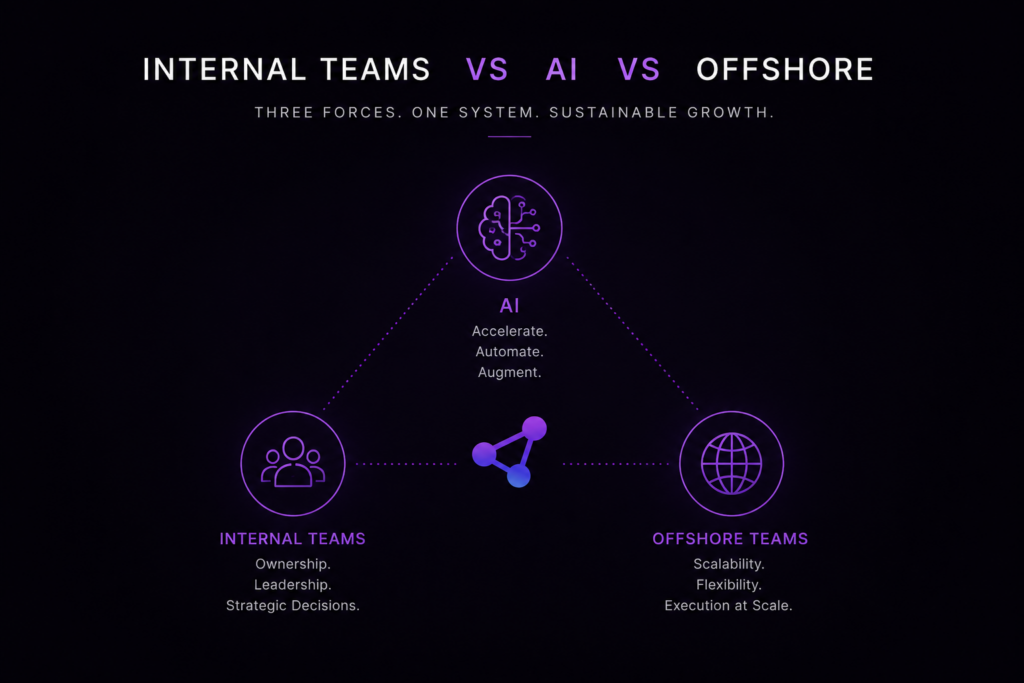
Internal for judgement.
Offshore for scale.
AI for acceleration.
So What Actually Wins?
The companies likely to outperform over the next decade probably won’t be the ones who replace the most people.
They’ll be the ones who design the smartest systems.
That means:
Internal Teams for strategic ownership, brand, and executive decision making.
Offshore Assets for scalable execution where appropriate
AI for reducing low-value repetitive burden
But none of that works without operational design.
This is the part too many organisations miss.
AI is not a silver bullet.
Offshore is not a universal fix.
Internal hiring is not automatically safer.
Without:
- Clear workflows
- Clean data
- Defined governance
- Strong leadership
You’re not building efficiency.
You’re just reshuffling complexity.
Final Thought
There’s far too much fear-mongering and far too much bling optimism in this conversation.
The reality, as usual, is somewhere in the middle.
AI will absolutely reshape businesses.
But the organisations that thrive won’t be the ones who chase hype fastest.
They’ll be the ones who understand a simple truth:
Technology changes tools.
Strategy Changes outcomes.
And if your business model is still unclear, messy, or structurally weak…
No combination of AI, internal hires, or offshore support will save you from bad design.